Monday, December 7, 2009

Wired Teens


In Prow 100 this term, we have discussed the phenomenon of text messaging to a great extent, and one of our assigned readings was Kris Axman's "r u online: The Evolving Lexicon of Wired Teens." In his essay Axman quotes, "This is really an extension of what teenagers have always done: recreate the language in their own image" (248). When I was a teenager we used to pass notes back and forth in the hallways and in the classrooms, and yes the words that we spoke were different than the seemingly dull and conservative tones of our parents. The telephone was also a preferred means of communication, and I remember talking for hours at a time to my friends.

When I purchased a cell phone with a text messaging plan for my teenage son, I had no idea what I was getting him into. I wasn't really aware that text messaging had replaced the phone or the written note, but it definitely has. Kayla also addresses the issue of texting in her blog "Let's Talk Text Speak." My son gives me daily tips on how to avoid being caught text messaging in class, and how to actually send him a discernible text message. On an afternoon that I had planned to take him shopping for a Halloween costume I texted him: wll b fn 2 go lk @ Hlwn cstms! He texted me back: Why do u want to go lick @ Hllwn cstms?

Despite all the changes that my son's cell phone has ushered in, one thing remains the same: he is still the smart-ass he always was!

Spell-Off, Caleb Caswell

Penny.jpg


The day we held a spelling-bee in class, I did not have much confidence in my spelling ability. I assumed that I would be eliminated with relative ease and would sit after a question, or two. To my surprise, my word recollection ability was greater than I had presumed. After several turns at the board, my confidence grew in my ability. Rather than thinking through the phonetic properties of the word, the proper spelling would appear in my mind's-eye as soon as the word was said.


Where had I gained this knowledge? I rely on spell-check as much as any other individual, and oftentimes find numerous mistakes in the editing of my work. It is very possible, however, that through constant reading over a period of several years, I have subconsciously registered spellings for further use. Also, if much time is spent writing, one can get used to mentally 'visualizing' words, therefore helping them to recall them quickly and fluently. This can be invaluable to a writer, for as Cassiby has posted, "Spell-checkers on word processors are only so smart, and often cannot distinguish between verb tenses and other grammar mistakes." This can also extend into the spelling of words with several homonyms, such as there, their, they're, etc.


If ever in need of a site with helpful instruction in the way of homonyms, be sure to reference this site. Its extensive knowledge on the subject can be incredibly insightful.

Word Power

Michiko Kakutani's essay "The Word Police" provides a critical look at language and its ability to inspire certain feelings in a reader. She claims that, "the mood of political correctness has already made firm inroads into popular culture." This is so true. Much of the informative media that we process in such a materialistic culture is a product of the over-sensitive aspects of our popular culture. Most writing and "information" that comes from these spheres is centred around celebrities--movie stars, professional athletes, and internet sensations (a hint at our movement towards dependency on web media for information). As this type of journalistic trite is so readily available and consumed, so is the style of language used by the writers.
She also points out that, "no decent person can quarrel with the underlying impulse behind political correctness... but the methods and fervor of self-appointed language police can lead to rigid orthodoxy." Again, this is reflected in the same template-based articles of popculture writers. With little originality and incredible predictability, they spread the latest gossip (both good and bad), and simply outline the details of a celebrity's recent affairs, such as their professional work, the constant instances of relationship infidelity, and the latest nightclubs that were frequented by these people in a drunken and embarrassing state. How stimulating. I'm not a fan of this kind of writing, as I believe that it is only an attempt for a writer to fill words on a page in order to collect their paycheque. But I don't blame the writers for their creative crimes (they work for the Man too!), I blame a society that prides itself more on its elitist morons than its integral politicians (at least the ones that are still around) and innovative thinkers. Sure, publications that cater to everyone's interests exist, but how often do we hear in local news media about these people? Right now, the only things remotely political or science oriented that are talked about are the doomsday threat of global warming and President Obama's latest plane ride/photo op.
When we learn to accept the language for what it is, not what it can be, we might finally be able to shake this thin-skinned attitude towards certain words or expressions that are seen as unfavourable. Sarah Maludzinski also raises this point in one of her posts.

Word Power by Kayla Gaffney


Words have the power to change the way that people think. Politicians spin their words in speeches to make people want to vote for them. Bias-free language is a way to respect all cultures and ways of life while still maintaining the writers core subject. In "Bias-Free Language: Some Guidelines" by Rosalie Maggio, Maggio explains that one of the objections to bias-free writing is that it will be used to a point of absurdities. Critics say that using bias-free language would lead to extreme changes in words, such as using personhole cover instead of manhole cover. Changing these words to keep bias out of writing would lead to the need for new dictionaries to be to be re-wrote. 

I agree with a post that Muriel Mapa made on the same subject. There are already multiple restrictions on how writers are supposed to write. Taking word choice away from writers would lead to books and articles being what they were not meant to be. A writer who wanted to write in a different time period would not be aloud to use terms that were popular in that day and age because people might find them offensive. I stand with Michiko Kakutani, who is the writer of "The Word Police." In this article, Kakutani agrees with the fact that writing should not discriminate, yet also believes that radical changes in certain words takes away the fundamental meaning of that word. Are we really going to take to extreme measures so that Pet Cemetery becomes Animal Companion Graves. 

Power to the Bias Free Language!

I myself have never been able to find out precisely what feminism is: I only know that people call me a feminist whenever I express sentiments that differentiate me from a door mat or a prostitute. ~Rebecca West, "Mr Chesterton in Hysterics: A Study in Prejudice," The Clarion, 14 Nov 1913, reprinted in The Young Rebecca, 1982

In Rosalie Maggio’s “Bias Free Language” essay, she answers the question: “Isn’t is silly to get upset about language when there are so many more important issues that need our attention?” (444). Maggio’s answer is a resounding no, and she explains that one’s speech is interconnected with one’s thoughts and behaviour. I agree that it is important to consider our word choice, and the power that we have to influence, offend or hurt another person with the language we use. I know that there have been times in my life when I have been quick to speak, and in doing so have unintentionally hurt or offended someone. I also agree with Maggio’s statement “Language both reflects and shapes society” (443). I am sure that there are major historical catastrophes that could have been avoided if someone had taken the time to rethink his or her word choice and the effect that it could have on another person or people. When I consider the power that language has to manipulate or dehumanize, Hitler’s treatment of the Jewish people comes to mind; the language he used within his hate propaganda greatly contributed to the holocaust.

“The Word Police” by Michiko Kukutani is a sarcastic rebuttal to Maggio’s essay, and does make some good points about “the excesses of the word police”: “The ‘pseudogeneric he’ we learn from Ms. Maggio, is to be avoided like the plague, as is the use of the word ‘man’ to refer to humanity…The politically correct lion becomes the ‘monarch of the jungle,’ new-age children play ‘someone on top of the heap’, and the Mona Lisa goes down history as Leonardo’s “acme of perfection” (454-455). Humour aside, Kukutani’s main point is that “intolerance (in the name of tolerance) has disturbing implications” and distracts attention from “the real problems of prejudice and injustice that exist in society at large, turning them into mere questions of semantics” (455-456). Although I agree that we shouldn't let our perplexing over "questions of semantics" take our focus away from societal problems, I think what Kukatani fails to acknowledge is that language does lead to prejudice and injustice. Lauren discusses the importance of striking a balance between bias-free language and a ridiculous censorship of speech in her "Word Power" blog.

As a woman I am grateful that a more politically correct climate of language has been ushered in. I have cringed when I have heard some of the more blatant sexist stereotyping and language. I have been called “little lady,” “sweetheart,” or “honey” by men I don’t know. I have heard men curse under their breath at a “woman driver,” I have been asked by potential employers if I have children, and how will I handle this sort of job with a family, and because I do have a family I have been asked by acquaintances if I have ever heard of birth control. When I hear someone use the word hysterical to describe a woman, I am reminded that the origin of the word is connected to an ancient Greek belief that women were diseased “because blood from the grotesquely misshapen uterus somehow infected a woman’s brain.” I am grateful that Albertan women were given the right to vote in 1916, and in 2009 we should be given the right to a bias free language. I would hold up my demonstration sign with Nellie McClung any day!

Let's Talk Lexicography by Kayla Gaffney


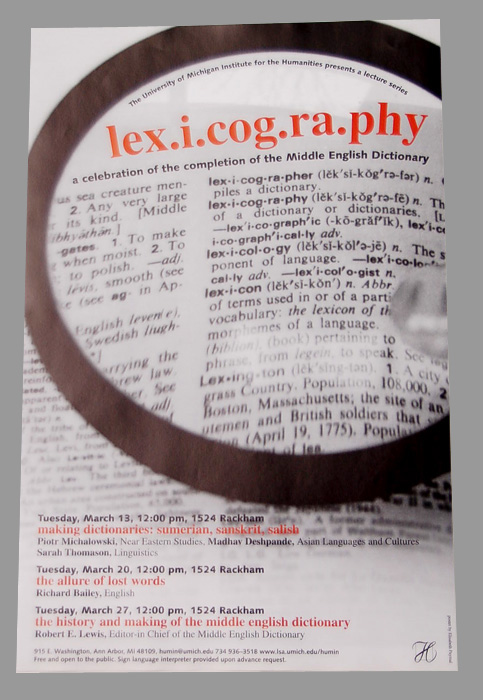
One of our in-class exercises was to watch a video of Erin McKean. She added a new word to my internal dictionary, which was lexicography. The Merriam-Webster online dictionary defines lexicography as the editing or making of a dictionary. When McKean first introduced this word I had no clue to what it was. McKean brought to light that dictionaries are becoming a dying force. People are using online forms of dictionaries to fulfill what a simple paper-back version could. People are getting lazy when it comes to their education by taking the easy way out. Picking up a dictionary and actually learning what a word means, or how to spell it is the only way to properly learn. 

Shawna Blumenschein makes a similar statement in her own blog post. She states that "Learning from errors is the key to avoiding them in the future." Searching for the correct spelling of a word online makes it easier to forget the journey after you have found what your looking for. The speed of online dictionaries take away any actual learning ability. I realize I have contradicted myself because I used an online dictionary to define lexicography. While these dictionaries take away the journey of learning a word, they are extremely accessible. As I type away at this blog post, I can simply open up another tab and find a specific word extremely quickly. I may not remember the definition of lexicography a few days from now, but at least I know it for this blog post. 

The Last Post by Shayna Fehr


Over this last term, I feel I’ve grown so much in my writing. I believe this is because of my newly found knowledge in grammar. Unlike Jennifer Kerr, blogging is not a new phenomenon for me. I’ve started a few blogs before, but as soon as I found myself a little busy, I dropped my regular blogging regime. However, as this semester grew more and more hectic, I didn’t have the luxury of dropping this blog. I’m glad I didn’t. I enjoyed this project, for it made me use my new skills in grammar.

Most people who know me, know I’m not a great speller. I remember back to elementary, when I had to take a weekly spelling test. Every Friday my teacher would hand out the class’ tests. This brought with it an anxiety attack like none other for this sixth grader. Those feelings came rushing back when Jessica asked us to line up in the middle of our classroom to perform a similar testing. I remember wanting to hide under my desk. Not only has this class made me use grammar, but perfect my spelling. When I’m typing furiously, and make a spelling error; I don’t reach automatically for spell check instead I inspect the word. Maybe I could fix it on my own? Most times, you know I’m right. I can fix the word without any help from technology. This class has been a great help with both spelling and grammar.

My posts:

Introductory Blog Post

Grammar Detective

Importance of Punctuation

Add a little Spice

Learning is a process

Word Power

My comments:

http://prow100.blogspot.com/2009/11/mysteries-of-english-language-by.html

http://prow100.blogspot.com/2009/12/word-power.html

http://prow100.blogspot.com/2009/12/joy-of-spelling-in-english-by-ramona.html?showComment=1260214345235_AIe9_BGwn3lKfOThWnOEzmngsIqWOdz2DO3Y7TyjuhE9oUylkbPGLdzXPScrdFbh76spE5hwPYrQYYlIuYdl0LQbXn07BIo0JP1rrps1Nvv3jSfFwZtxuUTx3K0Wx4YAhrMMgKkjLOwyk_KQQlXl4BytaTPNgRwD-dGhMe1EFVCbrCkbcPjUNHXJutN6_6t6meUY2XiJthqxUhpheswKqMs8M86Za9k1b-1f3_EjftJ4FwCWkxXwGDLmC92LSurBXrov8RKuiWiV#c373485068949818689

http://prow100.blogspot.com/2009/12/too-many-modifiers-jennifer-kerr.html?showComment=1260214535906_AIe9_BH2suD_kkFt3toxJToNjg9shISwIOs9BbdEKsTzi01tZDvDeKj41Sm_k7rKm0m9qgYjj8U1JZbE6OaBKtFDQphM883GPW5V_Ry3jP4zHz2LqFwncPjiDR-0ssKTccCEUGKokFkpMlf6pg6kQExzOHn5hHa28Rp4Fb_wxATPMrGxVRf7Y3C_lEFo-RX5DRM5uB9x4EanLOu4xnwaxTAXfG3BRWWiE_h6adgammydcMZHhx3f49I#c399828923772550784

http://prow100.blogspot.com/2009/12/sentence-structure.html?showComment=1260214738784_AIe9_BFPrE4plr0YaoEa--nVLBazEm1JxVd0mjuWBn9u_Rd9gnqefhT3BvIp5YmRX6aNoAZy4phlMD4pda1Swo6Cl7EtDAum2zmfatsgwS4DY94JRQGpbJPpze_wkq9KahmLy2bNYLMo7qYQC1m4AcO_cAu_qPCB0TEfcGxnI6orp4fcI7hn7GNh1zpP9X5WQjGDg8dHezmLq5JjuafgAmwLi1142zQFTvaJUClc8xtq_P73WoPFRyw#c6723712138763651168

http://prow100.blogspot.com/2009/12/comma.html?showComment=1260214895328_AIe9_BELppeMpgW3S4UVumh_kZm9XV7dE68xnJ9AGzu3Pq0QtyM16NR1OzQLi-qYD3_hweXD1KUiQrMBdgPTcXQ_Ay0hhdrjbPwj36QuwHafFoXdQGOYGB81MBv3j9K2KD52UplgKtdHcAZnQvqbbrlKrI3LlYqRUnNZD8AbqQcPOzN4spjQ32eKcuBGRcMmCPABVoa6_b7GoAin8LV885fbMD2OTSy7RQ#c6051416829106514535

http://prow100.blogspot.com/2009/12/word-power-by-kayla-gaffney.html?showComment=1260215135267_AIe9_BHsg7T7lBxNEd_d9ddMo6Zqnf6JeUCuNZIcAmVMOrWek0-Z1CZ6ZV8oo8pvyfDBKrXDr5EcNpVXSX4zvOUVwnx6PwXCXaQvdS3jL1o0RAmqITi8w-lwAlnfkEHBJQmOPhaawMe-T0QwsjG_YqPmgmWt63UU-3ZsqN4myDmGCWrxoJvE792EXjjZB0ORdlNoxhJXY0lipXnPe4xOpgyju2Ad-ubCTkS_yIJ3EX14whEz2kX5J2A#c2551157435730616660